

The New Luxury Buyer: Why AI Wealth Could Be Particularly Well Suited to Wine Country
The AI boom is creating extraordinary new wealth in the Bay Area. The more interesting question may be what this generation will consider worth buying.
Much has been made recently about the extraordinary wealth being created by artificial intelligence—and what that wealth could ultimately mean for Bay Area real estate.
The numbers are difficult to ignore. Luxury home prices in the Bay Area have risen significantly faster than the broader market since the launch of ChatGPT. San Francisco luxury sales have surged. Buyers with substantial equity compensation are bringing more purchasing power to transactions. And Redfin recently estimated that the potential after-tax equity held by current and former employees of just OpenAI and Anthropic could theoretically equal nearly 30% of the value of all residential real estate in the San Francisco metro. (Redfin)
That has naturally led to speculation about where some of this wealth might eventually go. Here in Wine Country, the conversation has already begun: Will newly wealthy technology founders, executives and employees increasingly look north?
Perhaps. But focusing only on where the money may move risks missing a more interesting question: What if the kind of luxury this new generation of wealth is seeking is changing as well?
The Ingredients of Luxury Aren’t New. The Recipe May Be.
There is a temptation whenever a new generation becomes affluent to declare that it has reinvented luxury. The evidence suggests something subtler.
Privacy, craftsmanship, scarcity, exceptional locations, service and quality have defined luxury for generations. They still do. Nor has status disappeared. What appears to be changing is the relative importance of different attributes—and the way affluent consumers use luxury to express identity.
Recent reporting on the new generation of AI wealth has found strong demand for personalization, efficiency, health, functionality and exclusivity across everything from automobiles to private aviation and yachts. (Financial Times) Luxury real estate research tells a similar story, with architectural quality, turnkey condition, personalization, wellness and long-term livability becoming increasingly prominent alongside traditional luxury attributes. (Coldwell Banker Global Luxury)
The old ingredients haven’t disappeared. The recipe is changing.
From More to Better
For a long time, one of the simplest ways to communicate residential luxury was scale: more square footage, more rooms, more elaborate finishes, more amenities.
Size still matters. But increasingly, size alone may not be enough. Architectural quality, materials, flow, natural light and the relationship between the home and its surroundings can carry as much weight as sheer magnitude.
I’ve seen that distinction firsthand in my own listings.
One recent example is an exceptional approximately 5,400-square-foot home, impeccably maintained and beautifully situated, but built in the early 2000s and now competing against new construction nearby. One prospective buyer seriously considered it but ultimately decided that the effort required to update the residence was more than they wanted to take on. Instead, they purchased a newly constructed home only a few doors away for nearly $1 million more—even though the new home was almost 1,000 square feet smaller.
That tradeoff is revealing. They weren’t paying for more house. They were paying for contemporary design, turnkey condition, and the ability to move directly into the lifestyle they wanted.
Luxury, in that sense, may increasingly be measured not only by what a property contains, but by how effortlessly it allows its owner to begin living.
Wellness Moves Into the Home
Something similar is happening with wellness.
Affluent consumers have pursued health and fitness for generations. Pools, gyms and spas are hardly new. What is changing is the degree to which wellness is becoming integrated into the architecture and infrastructure of the home itself.
Sotheby’s International Realty identified longevity-driven living as one of the defining forces influencing high-net-worth buyers in 2026. Wellness real estate has more than doubled globally in five years, and the category is projected to surpass $1.1 trillion by 2029. (Sotheby’s International Realty)
I recently saw this play out in another of my own listings. The buyers purchased a beautifully designed Wine Country residence and are now having the builder construct an entirely separate structure devoted to wellness, including a sauna, exercise space, and other elements designed specifically around their health and daily routines.
This isn’t simply a gym tucked into a spare bedroom. They are deliberately creating a wellness ecosystem around the way they want to live.
Wellness is moving from amenity to infrastructure.
Bespoke—Without the Burden
Another apparent contradiction may help explain today’s luxury buyer: the desire for personalization is growing, but so is the desire for ease.
Affluent buyers may want highly individual homes designed around their particular tastes, routines and interests, while simultaneously wanting ownership to demand very little effort from them.
They want bespoke. They also want frictionless.
A five-acre estate can be luxurious. Spending every Saturday managing five acres may not be.
That helps explain the appeal of environments that combine distinctive residences with sophisticated property management, hospitality and service. At Stanly Ranch in Napa, for example, buyers can purchase fully furnished residences supported by resort-level services and wellness amenities (Stanly Ranch). Its senior sales director told Realtor.com that Bay Area technology professionals and venture capitalists now represent the vast majority of purchasers, with many maintaining primary residences elsewhere in the Bay Area. (Realtor.com)
The appeal isn’t simply the house. It’s the ability to arrive and immediately live.
Technology That Disappears
Technology may work the same way.
The most sophisticated luxury home isn’t necessarily the one with the most screens, switches and gadgets. It may be the one where technology becomes nearly invisible.
Climate, lighting, security, energy, audiovisual systems, connectivity and window coverings simply work. The property can be managed remotely. Backup power protects against disruption. Energy systems become more intelligent. Air and water quality can be monitored and controlled.
For a generation building its wealth around technology, sophisticated infrastructure may increasingly be assumed. But the luxury isn’t the technology itself. It is what the technology provides: less friction and greater control.
This is also where sustainability becomes more interesting when reframed as resilience. In Northern California, solar generation, battery storage, backup power, water management, fire-conscious construction, air filtration and efficient building systems are not merely environmental statements. They can provide autonomy—and autonomy has always had a place in luxury.
Experience May Matter as Much as Ownership
Perhaps the largest shift is occurring beyond real estate altogether.
Luxury spending has increasingly moved toward experiences—travel, hospitality, wellness, food and other difficult-to-replicate moments rather than possessions alone. That does not mean affluent consumers have stopped buying beautiful things. It means the value of those things may increasingly be connected to the experiences they make possible.
The same principle can apply to a home. A kitchen can be expensive because of the stone on the countertops and the names on the appliances. Or it can be extraordinary because of what happens there: dinner with friends, food grown outside the door, wine opened at the table, doors disappearing into walls on a summer evening.
The property becomes less an object to possess and more a platform for living.
And that brings us to perhaps the scarcest luxury of all: time.
Wealth has always purchased time in one form or another. But many contemporary luxury preferences can ultimately be understood through that lens. Turnkey condition saves time. Automation saves time. Service protects time. Wellness is partly an investment in healthy time. A second residence can change how time is experienced.
Perhaps one way to understand modern luxury is through the things wealth allows someone to control: their environment, their attention, their health, their schedule, their experiences and, to some degree, their time.
If Luxury Evolves, Does Its Geography Change Too?
That brings us back to Wine Country.
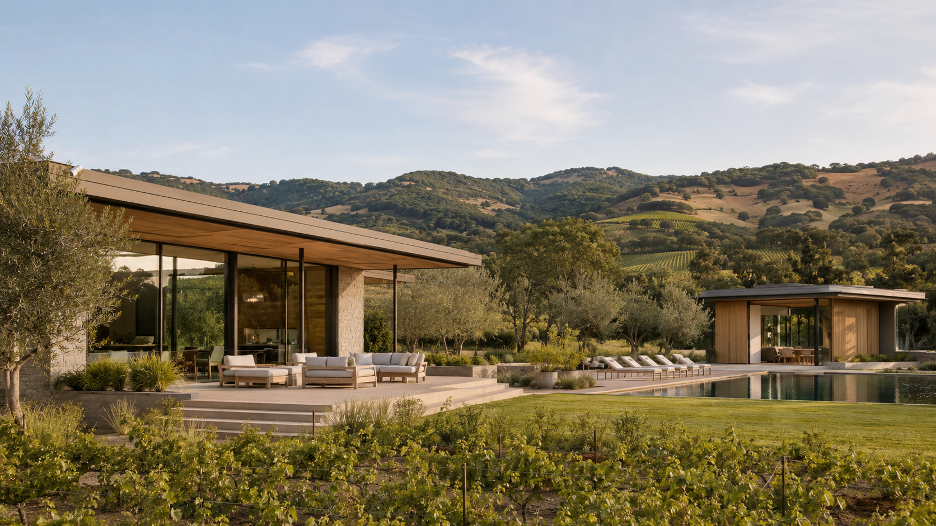
If an affluent buyer increasingly values intentional architecture, wellness, land, personalization, sophisticated technology, resilience, experiences and proximity to nature—while still needing access to one of the world’s most important centers of technology and capital—then Sonoma and Napa begin to present an unusual combination.
Not because these qualities are new here. Quite the opposite. Many have been here all along.
Acreage within reasonable reach of San Francisco is structurally scarce. Wine Country can offer meaningful physical space alongside architecture that responds to topography, views, mature trees, vineyards, changing light and the seasons.
Indoor-outdoor living has been a hallmark of California luxury for decades, but it becomes particularly powerful when combined with land and natural beauty. Wellness similarly feels less like an amenity when the surrounding environment participates in it through hiking, cycling, gardening, swimming, food, spas and nature.
And perhaps most interestingly, Wine Country offers the possibility of being exceptionally connected technologically while feeling profoundly disconnected experientially: connected when necessary, disconnected when desired.
There is something decidedly contemporary about that form of luxury.
The Early Signals Are Starting to Appear
There are signs that the overlap between Bay Area technology wealth and Wine Country is becoming more visible.
The buyer profile emerging at places such as Stanly Ranch is one example, particularly because many purchasers are not abandoning their Bay Area residences. They are adding Wine Country to the way they live.
That distinction matters.
Despite all the discussion about wealth moving north, the AI boom is simultaneously making San Francisco more important. Luxury demand there has strengthened dramatically, while AI companies continue drawing capital, talent and energy back into the city. (Redfin)
So perhaps the emerging pattern isn’t migration at all.
Perhaps it is duality: San Francisco and Sonoma. The Peninsula and Napa. An intensely connected professional life paired with an intentionally different personal environment. An urban primary residence combined with a Wine Country retreat—or eventually, for some, the reverse.
Wine Country does not require San Francisco to become less desirable in order to become more relevant. Both can become more valuable for entirely different reasons.
What Will the Next Generation Decide Is Scarce?
That may ultimately be the larger question.
Luxury has always been connected to scarcity. But what society considers scarce changes.
For the next generation of Bay Area wealth, some of the most valuable things may increasingly be space, nature, health, individuality, attention and time.
Artificial intelligence can create astonishing amounts of information, eliminate friction and generate virtually unlimited digital experiences. But it cannot create another acre overlooking the Mayacamas. It cannot quickly reproduce a mature landscape. It cannot manufacture an additional hour in the day. And it cannot entirely recreate the experience of stepping outside on a quiet Wine Country morning.
None of this proves that AI wealth is about to transform the Sonoma County luxury market. It is far too early to make that claim.
What the evidence does suggest is that an extraordinary new concentration of wealth is forming nearby at precisely the moment when some of the priorities shaping luxury are evolving.
The traditional foundations remain: quality, privacy, craftsmanship, scarcity and exceptional location. But increasingly they are being combined with intentional design, wellness, personalization, resilient technology, frictionless living and meaningful experience.
That combination is worth watching.
Because Wine Country may not need to reinvent itself to appeal to the next generation of Bay Area wealth.
It may simply turn out that many of the things this generation increasingly values have been here all along.
Ready to take the next step?
Whether you’re thinking of buying or selling in Sonoma County, I’m here to guide you through each stage of the process with clarity and strategy. From understanding market dynamics to structuring strong, well-positioned offers, my role is to help you move forward with confidence. Let’s talk about your goals and map out the best path forward.